

"AKC SCIENCE CLASSES"
CLASS 10 TH (CBSE AND MP BOARD)
CHAPTER 09
HEREDITY AND EVOLUTION
BASIC CONCEPTS
1) The progeny always has some variations from its parents :- These variations may be clearly observable. Over generations these variations accumulate and result in a progeny that is very different from its ancestors.
2) In asexually reproducing organisms, there are subtle variations over generations. In sexually reproducing organisms the variation is large over generations.
3) Variations result in organisms belonging to a species being different from each other. Some of the variations may be helpful to the organisms in the prevailing natural conditions and thus the organisms having such positive variations would survive. This concept is known as the "survival of the fittest".
4) Gregor Johann Mendel (1822-1884) is known as the "Father of Genetics". He experimented with pea plant (Pisum sativum) and brought out the three rules of inheritance
- Law of dominance
- Law of segregation
- Law of independent assortment.

Genotypic ratio :— TT : Tt : tt = 1 : 2 : 1 and Phenotypic ratio :— Tall : Dwarf = 3 : 1.
This indicate that both tall and dwarf traits were inherited in F1 generation but only tall trait was exhibited in all the progeny. Thus tall character (T) was dominant over dwarf (t) and so that dwarf character was not depicted even through it was present in F1 generation plants (law of dominance). Traits like 'T' are called dominant traits while those like 't' are called recessive traits.
6) If pea plants with two different pairs of characteristics (e.g., tall/dwarf and round seeds/wrinkled seeds) are bred with each other, the F1 progeny would have all tall plants with round seeds. This implies that round seed is a dominant character over wrinkled seed. In F2 progeny there would be some tall plants with round seeds and short plants with wrinkled seeds. However, there would be some plants with mixed characters—tall plants with wrinkled seeds and short plants with rough seeds. This depicts that tall/dwarf trait and round/wrinkled trait are inherited independent of each other (law of independent assortment). The following Punnett Square explains this :-
Parents :- TTRR ✖ ttrr
F1 :- TtRr
F2 :-

= 9 : 3 : 3 : 1.
7) How do the traits get expressed?
A trait in an organism results from the action of proteins (e.g., growth hormone in plants is a protein which is manufactured from a gene). Each protein is made by information from the genes for the protein. In the example of pea plant, there are two genes for plant heightー'T' and 't'. 'T' is dominant over 't'. In a heterozygous plant (Tt), only the gene 'T' will be able to make proteins as it is dominant over the 't' gene. This protein would be the growth hormone which will result in the plant being tall.
8) Each parent contributes one set of genes to the offspring. These genes are located on DNA strands known as chromosomes which are present in pairs in an organism. Each cell in an organism has two copies of each chromosome, one each from each parent. The germ cells of the organism has only one member of the pair of chromosome. When two gametes fuse to form the progeny the pair of chromosomes is restored.
9) Sex determination :- In human the sex is genetically determined. Humans have 23 pairs of chromosome out of which 22 pairs have similar members. The 23rd pair in men has one chromosome termed X and the other shorter one termed as Y. In women both the chromosomes are similar and are X and X. The gametes in men are of two types having either X and Y chromosome, while gametes in females are of one type, i.e., all having X chromosome. Following diagram depicts sex determination in humans :-

10) Variations occur from one generation to the other because of errors in DNA copying and because of sexual reproduction. These variations determine the survival of a species in the prevailing natural conditions. A species which has such variations as are favourable to it in the present natural conditions would survive while those with unfavourable variations would perish. Thus, ultimately only the species with favourable variations would be present. This is known as natural selection. A species which each adapt to the changing environment would survive. When, over several generations, as population of organisms become so different from its ancestors (due to accumulating variations) that they (the ancestors and present progeny) are not able to reproduce with each other, the population would constitute a new species. This phenomenon and the process through which new species are formed is known as evolution. Evolution is the generation of diversity and acting upon this diversity by natural selection.
11) Acquired and inherited traits :- The traits which are acquired by an organism during its lifetime are acquired traits. These traits are not inherited as these are changes in the non-reproductive tissues of the organisms. Only the variations in the reproductive cells can be passed on to the next generation.
12) Origin of life on earth :- Life originated on earth from inorganic elements and compounds such as Nitrogen, Carbon, Hydrogen, Methane, etc., which are the constituent elements of proteins, carbohydrates, etc. Under conditions of high temperature in the primitive earth environment, these inorganic elements combined to form various complex compounds such as the amino acids which are constituents of proteins.
13) Speciation :- Geographical isolation of two populations of same species over several generations may result in genetic drift and the populations which once had similar genetic make up would become different. Further natural selection acts on these isolated populations differently. If these difference accumulated over generations become so prominent that the two populations cannot reproduce among each other (reproductive isolation), a new species is said to be formed.
14) The more characteristics two species have in common, the more closely they are related. Classification of species is a reflection of their evolutionary relationship.
15) Homologous organs :- These are the organs which perform different functions but have similar structure and origin. For example, aa wing of a bat, flipper of a seal, front leg of a horse and arm of a man perform different functions but have the same structural plan and origin. This makes it evident that these animals have a common ancestor.

Homologous organs
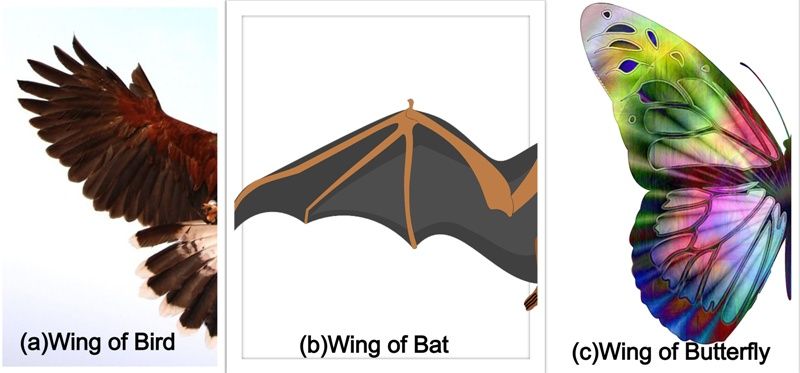
Analogous Organs
17) Fossils :- The preserved traces of living organisms are called fossils. The age of the fossil can be determined by detecting the ratios of different isotopes of the same element in the fossil material.




